
After a work injury, one of the first questions is practical: How much will workers’ compensation pay me? The answer depends on your average weekly wage before the injury, whether you can return to work, the type of benefits you qualify for, and the date of your injury. Massachusetts workers’ compensation does not simply replace every dollar of lost pay, and the weekly maximum can change from year to year.
The system generally does not require you to prove that your employer was negligent. Under Massachusetts General Laws chapter 152, section 26, you must show that you are covered and that the injury arose out of and in the course of your employment. The insurer may still dispute whether the injury is work-related, how much you earned, or how the injury affects your ability to work.
For an injury on or after October 1, 2026, Massachusetts’ maximum weekly compensation rate is $2,007.20. That is a ceiling used in calculating certain benefits—not the amount every injured worker receives. Temporary total benefits are generally calculated at 60% of the worker’s average weekly wage, subject to statutory rules and the applicable maximum and minimum rates.
At Percy Law Group, PC, we help injured workers understand how these calculations apply to their earnings, medical condition, and ability to work. This guide explains the main benefits available under Massachusetts law, how the weekly amounts are estimated, and what records can help make sure the insurer has the right information.
Massachusetts Workers’ Compensation Rates for 2026–2027
Massachusetts adjusts its minimum and maximum weekly compensation rates each October. The rate table is tied to the date of injury, so the applicable figure may not be the rate in effect today if your injury happened earlier.
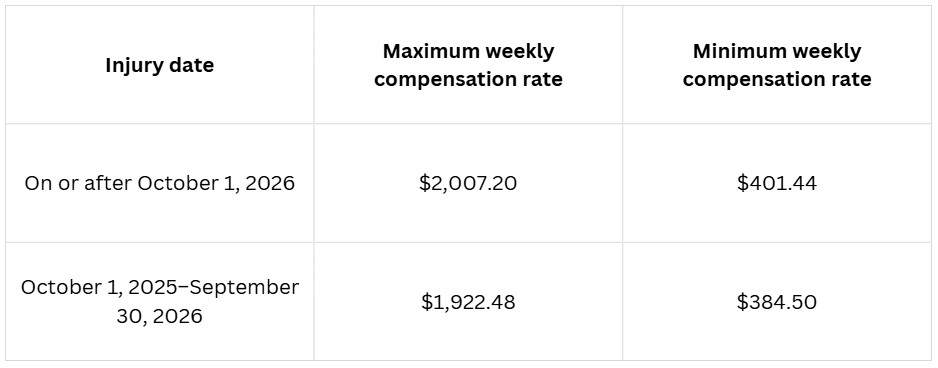
The minimum does not operate as a universal weekly floor for every kind of benefit. For example, the statute governing temporary total incapacity benefits provides that if a worker’s average weekly wage is below the minimum rate, the weekly payment equals the worker’s average weekly wage. Permanent and total incapacity benefits use a different minimum rule. The injury date and benefit type both matter.
Benefit types at a glance
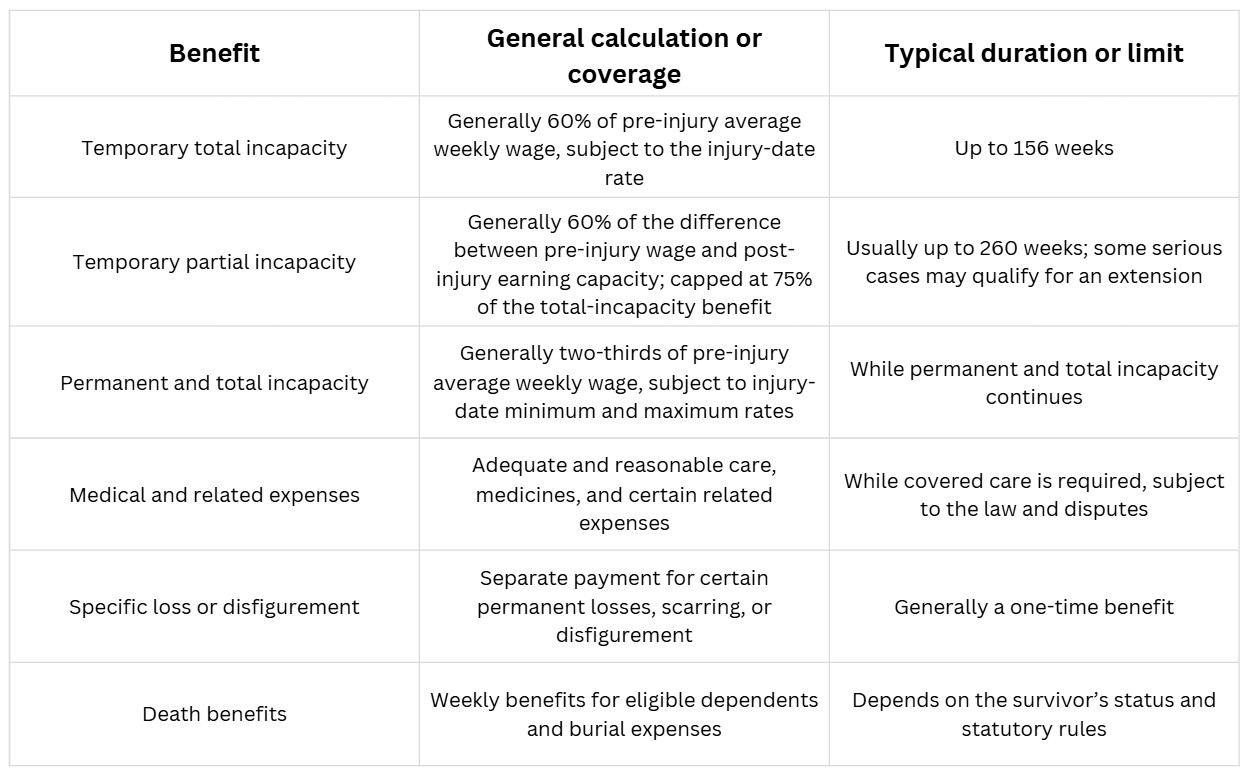
For a quick estimate of temporary total benefits, multiply your average weekly wage by 60%, then compare the result with the maximum rate for your injury date. For partial benefits, the calculation starts with the difference between your pre-injury wage and the wage you are capable of earning after the injury. These are starting points; the legal calculation may depend on wage records, work capacity, and other facts.
How Massachusetts Calculates Your Average Weekly Wage
Many weekly workers’ compensation benefits start with your average weekly wage before the injury. Massachusetts General Laws chapter 152, section 1 generally calculates it using earnings during the 12 calendar months before the injury, divided by 52. If you lost more than two weeks of work in that period, the statute provides that earnings for the remaining period are divided by the number of weeks left after the lost time is deducted. If you had not worked for the employer long enough to use the ordinary formula, or the nature of your employment makes it impractical, the law allows consideration of what a similarly employed worker in the same grade and district earned. Overtime and bonuses may be included when calculating gross earnings.
Your average weekly wage is not always just your regular hourly rate multiplied by your usual hours. Payroll records, the time you actually worked, overtime, bonuses, and the work arrangement can affect the calculation. If the insurer uses an incomplete wage figure, each benefit based on that figure may also be too low.
Helpful records may include:
- Pay stubs and payroll summaries for the year before the injury
- W-2s and records of overtime, bonuses, commissions, or shift differentials
- Time sheets and schedules showing weeks or hours worked
- A written wage statement from your employer
- Records of any recent pay increase, promotion, or change in schedule
Percy Law Group, PC can review the wage calculation and compare it with the records used by the insurer. This can be especially important for workers with seasonal jobs, fluctuating hours, or a relatively short period of employment.
Temporary Total Incapacity Benefits: When You Cannot Work
Temporary total incapacity benefits, commonly called Section 34 benefits, may be available when a work injury or illness leaves you unable to work. Under Massachusetts law, the weekly amount is generally 60% of your average weekly wage before the injury, subject to the applicable maximum weekly compensation rate. Wage-loss benefits generally begin after the five-day waiting period: compensation starts on the sixth day of incapacity. If incapacity lasts 21 calendar days or more, the first five days may also become payable. The days of incapacity do not have to be consecutive.
Section 34 benefits can be paid for up to 156 weeks. A worker who misses fewer than six days may not qualify for weekly wage-loss benefits, but may still be entitled to medical-only workers’ compensation benefits for treatment of the work injury.
Example: estimating temporary total benefits
Suppose your average weekly wage before the injury was $1,200. Sixty percent is $720 per week. If you qualify for Section 34 benefits, $720 is the initial estimate, before considering the facts of the claim and any other applicable statutory rules.
If your average weekly wage was $4,000, 60% would be $2,400. For an injury on or after October 1, 2026, the weekly benefit would generally be capped at the current maximum of $2,007.20. A high wage does not remove the statutory cap.
These examples are estimates, not guarantees. The insurer may dispute whether the injury is work-related, the correct average weekly wage, or how long you are unable to work. The exact calculation should be checked against the applicable rate for the injury date.
Temporary Partial Incapacity Benefits: When You Can Work but Earn Less
If you can return to work but your injury prevents you from earning what you earned before, you may qualify for temporary partial incapacity benefits under Section 35. These benefits are designed to address a reduction in earning capacity, such as working fewer hours, moving to a lower-paying position, or being restricted to light duty.
The basic calculation under Section 35 is generally 60% of the difference between your average weekly wage before the injury and the weekly wage you are capable of earning after the injury. The benefit cannot exceed 75% of the temporary total benefit you would have received under Section 34. The usual maximum duration is 260 weeks, although Section 35 permits an extension in certain serious cases that meet the statute’s criteria.
Example: estimating partial benefits
Suppose your average weekly wage before the injury was $1,500, but after the injury you can earn $900 per week in suitable work. The difference is $600. Sixty percent of that difference is $360 per week. The insurer must also apply the 75% cap and the legal rules for determining your post-injury earning capacity.
The insurer cannot always use any job or wage figure it chooses. Massachusetts law looks at actual earnings and, in some circumstances, the wages you are capable of earning in work that is available and suitable for you. Your medical restrictions, education, training, work experience, and whether a proposed job is realistically available may matter. A written return-to-work offer can affect the analysis, so get advice before agreeing that you can perform duties that conflict with your medical restrictions.
Permanent and Total Incapacity Benefits
If a work-related injury leaves you permanently and totally unable to work, you may qualify for permanent and total incapacity benefits under Section 34A. The weekly amount is generally two-thirds of your average weekly wage before the injury, subject to the injury-date minimum and maximum compensation rates. For injuries on or after October 1, 2026, those rates are $401.44 and $2,007.20, respectively.
These benefits may continue while the permanent and total incapacity lasts. Eligible recipients may also qualify for cost-of-living adjustments under Massachusetts law. Whether a person is permanently and totally disabled is a medical and vocational question; the insurer may challenge the extent of the restrictions or whether the person can perform other work.
A serious injury does not automatically qualify as permanent and total. The question is not only whether you can return to your old job, but whether the injury prevents you from performing work in light of your medical limitations and other relevant circumstances. Medical opinions, work history, education, age, and vocational evidence can all be important.
Medical Benefits and Mileage Reimbursement
Workers’ compensation can cover more than weekly wage replacement. Under Section 30, an insurer must furnish adequate and reasonable health care services and medicines for an accepted work injury, together with expenses necessarily incidental to that care. This may include approved treatment, prescriptions, and certain medical supplies.
Massachusetts has rules about provider choice. An employer’s preferred provider arrangement may affect the first scheduled appointment. After that, the law generally allows an employee to select a treating provider, subject to statutory requirements and exceptions. The insurer may also request medical examinations or dispute whether proposed treatment is reasonable and necessary.
For travel to medical treatment, Massachusetts currently allows mileage reimbursement at 62 cents per mile, effective March 23, 2026. Keep a mileage log with the appointment date, provider, starting point, destination, and round-trip miles. Ask the insurer for its reimbursement form and submit the log and supporting information promptly. Mileage rates can change, so confirm the rate that applies to the travel date.
If an insurer denies or stops paying for treatment, you may be able to challenge that decision through the Department of Industrial Accidents. A medical denial can affect recovery and return-to-work planning, so keep copies of treatment requests, denial letters, and communications with the insurer.
Additional Benefits for Dependents
Massachusetts law may provide a small additional weekly payment for certain wholly dependent family members under Section 35A. The statute sets an amount for each eligible dependent and imposes limits on the total. The rules about who qualifies as a dependent can be specific, so tell the insurer and your attorney about children or other family members who rely on your earnings.
Permanent Loss of Function, Scarring, or Disfigurement
A work injury may cause lasting impairment even if you return to work. Section 36 provides a separate, generally one-time benefit for certain permanent losses of bodily function or sense and for qualifying disfigurement or scarring. The amount depends on the type and severity of the injury and the statute’s schedule and guidelines. It is separate from weekly wage-loss benefits and may be available in addition to other compensation.
The insurer may request medical evidence about the permanency and degree of the loss. Photographs, treatment records, specialist reports, and documentation of the way the injury affects daily activities may help evaluate the claim. Percy Law Group, PC can help determine whether a Section 36 benefit should be considered as part of your overall case.
Benefits for Family Members After a Fatal Work Injury
When a worker dies because of a work-related injury or illness, Massachusetts law may provide weekly benefits to eligible surviving spouses, children, and other dependents. A surviving spouse’s benefit is generally calculated using two-thirds of the deceased worker’s average weekly wage, subject to statutory limits and eligibility rules. Cost-of-living adjustments may apply in qualifying cases. The insurer must also pay reasonable burial expenses up to eight times the state average weekly wage, as provided by Section 33.
The amount and duration can depend on the relationship to the worker, dependency, age, student status, disability, and other facts. Families facing a fatal work injury should get legal guidance promptly so they can understand the available benefits and how to apply.
A Lump-Sum Settlement Is Not the Same as a Weekly Benefit
An injured worker and the insurer may agree to resolve some or all of a compensation claim with a lump-sum settlement. There is no automatic right to a lump sum; both sides generally must agree, and the agreement must be reviewed or approved under Massachusetts General Laws chapter 152, section 48.
A settlement can affect future weekly payments and other rights. The effect on future medical benefits and vocational rehabilitation can depend on whether the insurer has accepted liability or a decision has established it, as well as the terms and timing of the agreement. Before signing, consider your expected medical care, work prospects, outstanding liens, and the benefits you may be giving up. Do not compare the settlement amount only with the number of checks you have already received.
Why the Amount May Be Lower Than You Expect
An insurer may calculate or pay benefits based on its view of the case.
Common disputes include:
- The insurer used an incorrect average weekly wage or omitted overtime or bonuses.
- The insurer claims you can return to work or earn more than your doctor’s restrictions allow.
- The insurer disputes that the injury or illness arose out of and in the course of employment.
- The insurer accepts part of the claim but disputes a body part, period of disability, or treatment plan.
- The insurer argues that a medical condition existed before the work injury.
- The insurer stops weekly checks after a return-to-work offer or medical examination.
A payment decision is not necessarily the final word on the claim. If your benefits are denied, reduced, or stopped, read the insurer’s notice carefully and act quickly. The Department of Industrial Accidents has a formal process for disputing benefit decisions. Percy Law Group, PC explains the process in its guide, What to Do When Your Massachusetts Workers’ Comp Claim Is Denied.
Steps to Take to Protect Your Benefit Claim
Taking a few practical steps can help preserve important information:
- Report the injury promptly. Tell your supervisor or employer in writing and keep a copy. Include when and where it happened, what body parts were affected, and who witnessed it. Prompt notice helps create a record, but do not assume that an employer’s report alone starts or completes every step of your claim.
- Get appropriate medical care. Explain to the provider how the injury happened at work and describe all symptoms. Follow the treatment plan and ask questions if you cannot safely perform your job.
- Keep wage records. Save pay stubs, W-2s, bonus statements, overtime records, schedules, and time sheets for the period before the injury.
- Keep insurer documents. Save benefit notices, payment histories, medical denials, return-to-work offers, and requests for examinations.
- Track mileage and expenses. Record travel for medical care and keep receipts for prescriptions or other expenses you believe are related to the injury.
- Do not overstate or minimize your limitations. Describe your symptoms and restrictions accurately to your doctor and insurer. If a job offer conflicts with your medical restrictions, ask for clarification before accepting or refusing it.
- Ask how the insurer calculated the weekly amount. Request the average weekly wage it used, the injury-date maximum and minimum rates, and the benefit category it is paying.
When a formal claim may be needed
If you are disabled for five or more full or partial calendar days, your employer generally must file an Employer’s First Report of Injury (Form 101) with the Department of Industrial Accidents and the insurer. If you are out for fewer days, the injury may be reported as a medical-only claim to the insurer. If your employer has not filed the required report within 30 days, or the insurer denies benefits, you may need to file an Employee’s Claim (Form 110) with the Department of Industrial Accidents.
The general filing deadline is four years from when you first became aware of the causal relationship between your disability and your employment. A separate deadline applies when a work injury results in death. Do not wait until a deadline is near: a denial, medical dispute, or wage calculation issue can take time to address. The Department of Industrial Accidents explains how to file a workers’ compensation claim and the applicable statute of limitations. Percy Law Group, PC can help determine which forms and deadlines apply to your situation.
How Percy Law Group, PC Helps Injured Workers
The amount of workers’ compensation available to you depends on more than a single percentage. Percy Law Group, PC reviews the wage calculation, the benefit category, medical evidence, work restrictions, and insurer notices to identify what benefits may apply. Our attorneys represent injured workers throughout Massachusetts, including Taunton, Fall River, Dartmouth, Plymouth, and Bristol and Plymouth Counties.
Percy Law Group, PC has represented injured workers in Massachusetts since 1994. We offer free initial consultations for workers’ compensation matters and can explain the firm’s fee arrangement before you decide how to proceed. To learn more, visit our Massachusetts workers’ compensation benefits page or contact the firm at (508) 206-9900.
Frequently Asked Questions
What is the maximum workers’ compensation check in Massachusetts in 2026?
For injuries on or after October 1, 2026, the maximum weekly compensation rate is $2,007.20. The maximum for an injury on an earlier date may be lower. The maximum is a cap, not the amount everyone receives.
How much of my wages will workers’ compensation pay?
Temporary total incapacity benefits are generally 60% of your average weekly wage before the injury, subject to statutory rules and the applicable maximum. Partial incapacity benefits are generally 60% of the difference between your pre-injury average weekly wage and your post-injury earning capacity, with an additional cap.
Do workers’ compensation benefits include medical bills?
An insurer may be responsible for adequate and reasonable medical care, medicines, and certain related expenses for an accepted work injury. Medical treatment can be disputed, so keep records of requests, approvals, and denials.
Can I receive medical benefits if I did not miss enough work to get weekly checks?
Possibly. Massachusetts allows medical-only claims when a work injury requires treatment but the disability does not reach the threshold for weekly wage-loss benefits. Report the injury and ask that the medical bills be sent to the workers’ compensation insurer.
Can I receive workers’ compensation if I return to work?
Possibly. If you return with restrictions or earn less because of your injury, you may be eligible for partial incapacity benefits. The calculation depends on your pre-injury wages, post-injury earning capacity, medical restrictions, and other facts.
How long can I receive benefits?
Section 34 temporary total benefits are generally limited to 156 weeks. Section 35 partial benefits are generally limited to 260 weeks, with possible extensions in qualifying serious cases. Permanent and total benefits may continue while the incapacity remains permanent and total. Medical benefits may continue as long as covered care is required, subject to the law and any dispute over treatment.
Does workers’ compensation pay for pain and suffering?
Workers’ compensation generally provides wage-loss, medical, and specified additional benefits rather than pain-and-suffering damages. Whether another legal claim may exist depends on who caused the injury and the circumstances.
Talk With a Massachusetts Workers’ Compensation Attorney
If you are unsure whether your weekly check is correct, start by getting the insurer’s wage calculation and comparing it with your pay records. If the insurer has denied, reduced, or stopped benefits—or if your injury may cause a lasting impairment—Percy Law Group, PC can review the information with you and explain potential next steps. Call (508) 206-9900 to schedule a free initial consultation.
This article is for general informational purposes only and is not legal advice. Reading it does not create an attorney-client relationship. Benefit eligibility and calculations depend on the facts, the date of injury, and Massachusetts law. Current rates and procedures should be confirmed with the Massachusetts Department of Industrial Accidents.